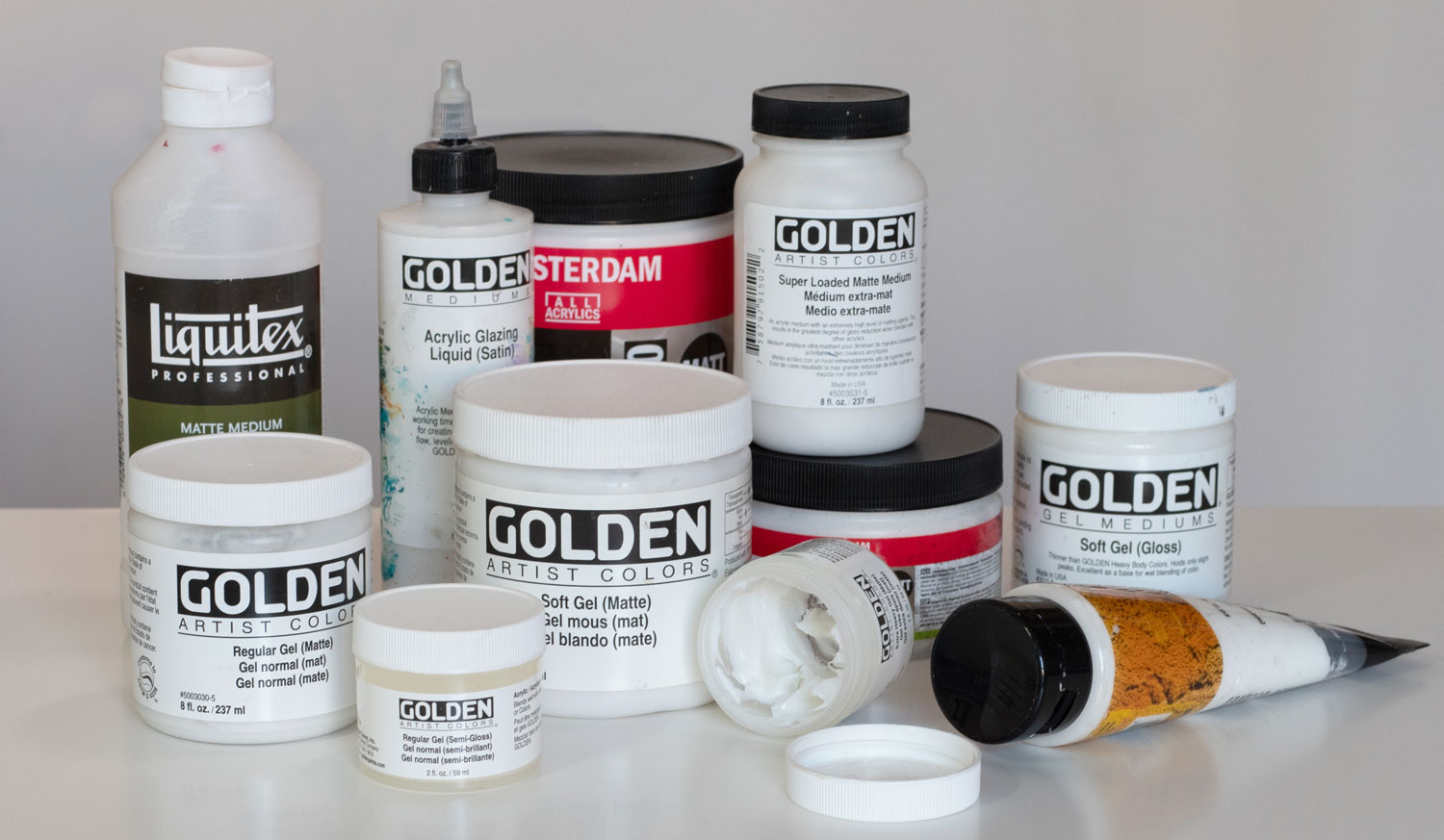
‘Gloss gel medium’, ‘matte medium’, ‘heavy gel’, ‘pouring medium’… If you’ve worked with acrylic paint for some time you’ve probably heard these terms before. Maybe you also have some of these products in your stash. In my in-depth mixed media class Drawing in the Soul we’ll be working with these products as well. But what are acrylic gels and mediums exactly? What are the differences between the various products, and what can they be used for? That’s what we’re going to look at in this article.
Acrylic paint is a relatively modern type of paint, first sold commercially in the 1950s. It’s made of pigment suspended in acrylic polymer emulsion. Acrylic paint is a fast drying paint, which means that you can quickly add new layers on top of each other and continue painting. It’s water-based, which means that you can clean your brushes and tools with water instead of having to use solvents. But when the paint dries it becomes water-resistant.
Now, if you ever went to a fine art store and looked around in the acrylic paint section, you have probably noticed that there are lots of products which can be used in combination with acrylic paints. These products change the properties of the paint, in different ways and for various purposes. Roughly these products fall into the following categories:
- Acrylic gels and mediums
- Translucent acrylic polymers which alter the properties of acrylic paint
- Examples: matte medium, extra heavy gloss gel
- Additives
- Other products (with or without acrylic polymers) which alter the properties of acrylic paint
- Examples: retarders, flow extenders, glazing liquid
- Pastes
- Opaque acrylic polymers which can be used to alter the properties of acrylic paint or to create a surface for acrylic paint
- Examples: molding paste (also called modeling paste), crackle paste, fiber paste
In this article we’re going to have a closer look at this first category: acrylic mediums and gels. I’ll discuss what they are, the differences between them, and the purposes they can be used for. I’ll cover additives and pastes in a future article.
What are acrylic gels and mediums?
Simply put: you can think of acrylic gels and mediums as acrylic paint without the pigment. So they are like a colorless paint. They consist of the same polymer emulsion that is the binder that holds the pigment of acrylic paint.
What are the main differences between gels and mediums?
The main differences between gels and mediums are the viscosity and the sheen. Those are also important for their practical use, which I’ll discuss further below. But first let’s have a look at viscosity and sheen.
1. Viscosity
The first difference between mediums and gels is their viscosity. This means how thick or thin the product is. Mediums are thin, liquid, and can be poured. Gels on the other hand have a buttery or even thicker consistency.
The pure polymer emulsion that is the basis of mediums and gels (and also of acrylic paint), is liquid. So in order to create thicker mediums and gels, the manufacturer adds a thickener to them. The thicker the product, the more thickening agent is being added.
Now, there is a bit of a confusion sometimes in the terminology. The whole range of these products, whether fluid or of a thicker consistency, are all ‘acrylic mediums’. A ‘medium’ in this context is a product that can change the properties of the paint. So if we want to be really accurate, the liquid types should be called ‘fluid mediums’ and the thicker types should be called ‘gel mediums’. However, in practice the fluid types are often just called ‘mediums’ and the thicker types are called ‘gels’.
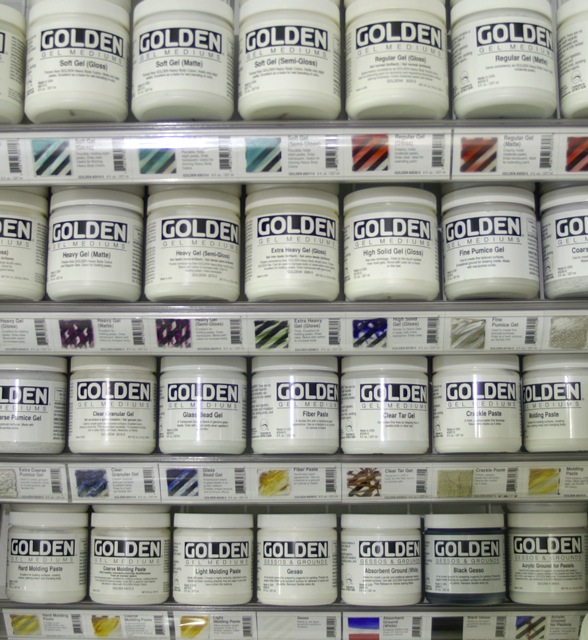
Different brands have slightly different names for these products, but in general you can range the mediums and gels in the following way from most fluid to most thick:
- Airbrush medium
- Polymer medium / Fluid medium (or just: medium)
- Soft gel
- Regular gel
- Heavy gel
- Extra heavy gel
2. Sheen
Acrylic gels and mediums come in a variety of sheens or reflectiveness. The most ‘pure’ or regular type is gloss. That is because the polymer emulsion which is the base of the mediums and gels, has a glossy sheen of itself. However, you can also buy mediums and gels in matte varieties. Those types have extra ingredients added to them which make the product matte. Sometimes you can also find ‘satin’ or ‘semi-gloss’ mediums or gels. Those have a sheen that looks a bit like wax or satin: in between gloss and matte.
So now you know that when someone refers to ‘matte medium’, they mean a liquid acrylic medium which has matting agents added to it so it doesn’t have any glossy sheen. Or when you hear mentioning about ‘heavy gloss gel, they mean that it’s a thick acrylic medium which has no matting agents, so it has a glossy sheen.
Now, regardless of the sheen, all gels and mediums look a kind of milky white when you apply them. But when they are dry they become clear, translucent. The matte varieties of mediums and gels are a bit less translucent than the gloss products, since they have a matting agent added to them. But they are all still quite translucent.
What are gels and mediums used for?
Acrylic gels and mediums can be used for various purposes, such as:
- Changing consistency of acrylic paint
- Changing sheen of acrylic paint
- Increasing transparency of acrylic paint
- Adhesive (glue)
- Texture
- Surface treatment
Let’s have a closer look at these different purposes.
1. Changing the consistency of acrylic paint
As I’ve mentioned above, all gels and mediums are essentially acrylic paint without the color. But one of the main differences between the gels and mediums is their viscosity or thickness. So this property can be used to change the consistency of acrylic paint.
The reason is that acrylic paint comes in a variety of thicknesses. You can buy fluid paints, soft body paints, heavy body paints, and so on. So if you have a certain paint and you want to change its thickness, you can use a gel or medium to do that. So if you want to make a fluid paint thicker, you can add some gel to it. Or if you want to make a heavy body paint thinner, you can add some medium to it.
2. Changing the sheen of acrylic paint
Different types, brands, and series of acrylic paints can have different sheens. Some are more glossy, others are more matte. So if you have a glossy paint and you want to make it more matte, you can add a matte medium or matte gel to reduce the sheen.
Sometimes (especially with more expensive artist grade paints) there can even be differences within the same series of paints. So for example an ultramarine blue color of a specific series of paint from a specific brand can be more glossy than a cadmium red of that same series of paint from that same brand. If you have used these colors in the same painting, you can get different sheens within that same painting, which you might not want. In that case, when you’re finished painting you can add a coat of medium in the sheen that you want (gloss, matte) and cover your whole painting so the sheen is uniform over the whole painting.
3. Increasing the transparency of acrylic paint
As I mentioned above, all gels and mediums are milky-white when you apply them, but they dry translucent. So if you want to make your paint more translucent, you can add a bit of medium or gel to it. It takes a bit of experience to learn how to work with this property, since the white color of the wet medium or gel makes the paint color initially a bit lighter, but changes to a translucent color when it dries. But with time you’ll learn how to work with these properties.
This translucent property is also the reason that acrylic paint is sold in different thicknesses, such as fluid, soft body, or heavy body. As I mentioned above, you can change the consistency of acrylic paint by adding a medium or gel to it, to make it thinner or thicker. However, this also means that the paint becomes more translucent. The more medium gel is being added, the more translucent your paint becomes. If you want to keep the opacity of the paint but want to change its viscosity (thickness), then it’s best not to add gel or medium but purchase the paint in the thickness (or fluidness) that you want.
4. Adhesive (glue)
Acrylic mediums and gels have very good adhesive qualities and can therefore be used as great adhesives or glues. You can use them as ‘standalone’ glue, or to combine it with acrylic paint (for instance if you want to glue something to a painting, or if you want to paint over something you’ve glued).
One example of this purpose is to use acrylic mediums or gels for paper collage. You can use liquid mediums to glue down thinner types of papers, like tissue paper or printer paper. For thicker paper like cardstock it’s best to use a gel medium, since it’s stronger and can hold thicker papers better.
Another way to use the adhesive qualities of gels and mediums, is for image or photo transfers. This is a technique where you transfer the ink of a printed image or photo onto a different surface, such as a canvas. The acrylic medium or gel will act as the transfer agent which adheres the ink (and sometimes part of the paper as well) to the surface.
5. Texture
The viscosity properties of gels and mediums can also be used to create texture. You can for instance use a gel to create impasto effects, or to work with a palette knife. You can mix the gel with paint to give it a certain color, or you can apply the gel directly to the surface (and paint over it if you like).
Another example of using mediums and especially gels for texture, is to add other ingredients to it. Artists use all kinds of products for this purpose, such as sawdust, eggshells, sand, and so on. There are also various ready-made specialty gels available that have extra ingredients added to create texture. Examples are glass bead gel, pumice gel, granular gel, mica flake gel, and more.
6. Surface treatment
The last purpose of acrylic gels and mediums that I want to discuss here, is for surface treatment.
You can use for example a gloss medium to seal a surface, in order to make it water-resistant or to protect the layers beneath. This will also make the surface fairly smooth, which can be used for instance to create special resist effects, or to create a smooth base to add glazes to.
Another example of a surface treatment is when you have painted with acrylic paint and want to draw with colored pencils or pastel pencils on top of it. Unless you use a very matte acrylic paint, the surface will usually be too slick for pencils. You need a bit of a rough texture (tooth) in order to draw with pencils. In that case you can apply a layer of matte fluid medium over the paint. The matting agents in the medium create a bit of a gritty surface, which is more suited for drawing.
So this was an introduction to acrylic gels and mediums. There’s a whole world that opens up if you start working with these products! I personally have a variety of mediums and gels, but I mostly use matte medium, regular & soft gel, and glazing liquid. And what about you? Do you use mediums and/or gels? Which ones, and for what purpose? Is there a purpose of gels and mediums that I didn’t mention in this article? I’d love to hear from you!

In-depth portrait class Drawing in the Soul
In my upcoming portrait class Drawing in the Soul we’re going to work with a variety of art supplies and techniques, including acrylic paint, glazing, and collage. That’s why we’ll also be using some acrylic mediums and gels.
Drawing in the Soul is an in-depth 12-weeks class, which starts from the fundamentals and then builds up to more advanced levels.
You’ll learn about the proportions of a front face, profile face, and three-quarter face. You will learn about fundamental art concepts like tonal value, line, and color, which are important for creating portraits. You’ll work with supplies like acrylic paint, charcoal, pastels, collage, and more. And you’ll learn ways to create focal points in your portraits, to help guide the viewer’s eye and to give your portraits more depth and interest.
Would you like to learn more about this class? Just click the button below.




Hello There,
I want to know if heavy or medium glossy gel can be used by itself, for example could I paint it on something using a release agent and would it stand up on it’s own. If I can use a release agent will that ruin one side for painting?
Thanks,
Mary
Hi Mary, yes, you can make so-called ‘skins’ from acrylic gel medium. You can paint a (fairly thick) layer onto a non-porous surface, such as a plastic bag. When it’s dry you can peel it off the plastic and then you can do many things with it, including painting it. The side that was on the plastic will be a bit more shiny and of course flatter than the other side, but afaik you can paint both sides. Depending on the thickness, you can also cut it, bend it, etc. If you search for acrylic skins you will find examples. Most often it’s directly made with acrylic paint, but since gel medium is the same as paint just without the color, you can use that too.
Hope this helps, and love to know your plans with it! 🙂
I just brushed a gloss fluid medium on a finished acrylic painting. After 2 dry coats of this, I was going to spray on a coat of clear varnish. Is this all I need to complete and protect my painting?
Thanks for your very informative post!
Very helpful for me.
Hi Deb, if necessary you can spray multiple coats of varnish. I’m not an expert in this field, but I think that should be enough. Glad you liked the article! 🙂
just wondering – can a matte gel be thinned down with water to make and be used as a matte fluid medium ?
Hi Ann, you can certainly thin down a gel medium to make it a bit more fluid, but I’m not sure if you can take it all the way to the consistency of a fluid medium without losing its main properties. The amount of water relative to the amount of remaining gel medium may become too high.
This article is so perfectly helpful. Thank you so much for sharing your knowledge.
Thanks so much Rania, glad it was helpful!
This was so helpful – thank you!
Happy to hear that Amanda! 🙂
I paint reborn dolls with artist grade acrylics. I also have taught classes to beginners on how to paint reborn dolls and I run a FB help group (The Reborn Connection) on air dry painting of reborn dolls. I recently posted a link to this article on my FB group because it covers things so well in an easy to understand manner. The subject of which mediums to use comes up all the time and is one of the most often asked questions I get. Thank you so much for putting this information out there as a resource!
Great to hear that this information was helpful to members of your FB group Angie! Thanks for sharing! 🙂
Excellent and informative article! I use and sell these types of products and sometimes in formulating them I get confused just trying to make sense out of reading labels or worse yet, the brief and incomplete descriptions some online vendors offer when selling them. I’ve wasted a good bit of $$ over the years in trial-and-error. Very grateful for what I’ve learned here today. Thank you.
So great to hear that Stephanie! Yes, this info is hard to find and yet so important because we use these products a lot in our art. Awesome that you found it helpful!
That was exactly what I needed to know – thank you. I watch YouTube videos and the artists use all of these products, but I’ve never seen an explanation as to why they picked one over the other.
It all makes sense now. Thanks again.
Yes, it can be quite confusing indeed, so I’m happy to hear that this makes it more clear! 🙂
This article is exactly what I needed. Thank your for taking the time to share your knowledge with us! You mentioned a possible future article on additives and pastes. Have you had a chance to write that? If so, I’d love to read it. Will you please post a link to it?
Thank you!
Thanks so much Marie, I’m glad you found the article helpful! I haven’t had the time to write the article on the additives and pastes yet. But when I do I will announce it through my mailing list and I will also post a link here. 🙂
Thanks for your explanations about gels and mediums. But where do glazing liquids come in? Is it just a different name from different brands for similar products? For instance I have Liquitex Glazing Liquid (which says it is a medium), and Golden Mediums.
Hi Elizabeth, good question! A glazing liquid is a medium intended to be used for glazing techniques, meaning applying thin coats of translucent paint.
I mentioned glazing liquid in this article as an additive. That’s because most glazing mediums have some type of retarder agent, in order to not let the medium dry as quickly (especially since a glaze is meant to be applied in thin coats and therefore dries very quickly). For this reason, personally I wouldn’t use glazing liquid for other purposes like gluing, although I imagine it’s possible in theory.
Regarding your question about Liquitex Glazing Liquid vs Golden Mediums: the latter is a generic indication of the category of acrylic mediums as a whole, wheras “Liquitex Glazing Medium” is the name of the specific glazing product by Liquitex. In fact, Golden has a glazing medium as well, which they call “Glazing Liquid”.
Hope this helps, thanks for stopping by! 🙂
Thank you I’m looking for something to explain .
Thanks for stopping by Illya. Hope this worked for you! 🙂
I want to thank you very much, for the clear explanation at a glance … I have the most mediums and most recently the heavy gel in ‘my stock’ … Thanks to your explanation about medium and gels regarding a transfer function, understand i like the phenomenon, whow I am very happy. I also use a substrate especially for pastels and watercolor and I have the crackle, a super medium to use for example alongside watercolor. Top article written by you 👍🏽 thanks!
Happy to hear you found the article useful Birgitta! Yes, crackle paste is fun, isn’t it! I’ve used it too, but not a lot of times. Should use it more often! Thanks so much for stopping by! 🙂
Hi Juna! Thanks for this lovely post. I learned from you that I can use matte medium to mix with acrylic paints for glazing but always seem to forget. That is until last night which I did use; funny how I woke up to this post. I mostly use all matte mediums: fluids for gluing thin pieces and the soft & heavy gels for thicker & 3D objects.
I love crackle paste but don’t use it as much.
I had a tube of Fiber paste given to me and made my own “paper skins”. I tucked them away and recently used it in a mixed media project. Fiber paste, when dried, takes on the quality of watercolor paper & becomes absorbent.
I have also mixed some gloss varnish with matte medium to get a “satin” finish to seal acrylic paintings.
Great to hear about your experiences with gels and mediums Julie!
Yes, matte medium works well for glazing. Even better (if you have it) is to use gloss medium, since it’s more transparent (no matting agents in it). But they both work.
And thanks for mentioning fiber paste! I do have a little jar of it, but never used it. I should try it out!
Wonderful article! Thank you for ideas on how to use these products.
You’re very welcome Cheri! Thanks for stopping by!
This was very informative. I have used matte medium and gel mostly for adhesive purposes. and texture paste on stencils and just add interest on projects, and glazing medium. Thank you for this interesting article!!
Yes, mediums and gels work very well as adhesives! I love to use glazing medium too. Glad you found the article informative Ginny!
This was very helpful and informational. Thanks so much!
You’re welcome Esther! 🙂